
 Sandra Dirks
Starting August 2, 2026, the transparency obligations under Article 50 of the EU AI Act will apply to anyone publishing AI-generated content.
Looking for the German Version?
Starting August 2, 2026, AI-generated and AI-modified content must be clearly and visibly labeled. What this means in practice, which obligations will apply to you, and how to prepare your processes accordingly — that is what this article covers.
⚠️ Note: The contents of this article do not constitute legal advice. They provide a practical overview of the AI labeling requirements under the EU AI Act. For legal assessments in individual cases, we recommend consulting legal counsel.
What are the AI Labeling requirements?
Artificial intelligence has become an integral part of content production. Whether it is AI-generated product imagery in e-commerce, synthetic campaign visuals, or automatically generated text, the lines between human-created and AI-generated content are increasingly blurred. That is exactly where the AI labeling requirements come in.
With the EU AI Act (Regulation (EU) 2024/1689), the European Union introduced the world’s first comprehensive legal framework for regulating artificial intelligence. One central element is the transparency obligation under Article 50 of the AI Act. It requires companies and content owners to clearly and transparently label AI-generated or AI-modified content so that consumers can recognize at first glance what they are dealing with.
Two key dates you need to know
The AI Act does not take effect all at once. Instead, it applies in stages. For content processes, two dates are especially relevant:
- August 2, 2026: The visual labeling requirement takes effect. AI-generated and AI-modified content must be visibly identifiable as such at first glance.
- December, 2026: The machine-readable marking requirement follows. Content must also be technically marked — for example, through metadata — as AI-generated or AI-modified.
Anyone already using AI in content production should now review their processes to make sure they are prepared for both dates.
Who do the labeling requirements apply to?
The labeling of AI-generated content is not an obligation that applies only to large technology companies. It applies to anyone publishing AI-generated or AI-modified content, including:
- E-commerce businesses using AI-generated product imagery
- Agencies responsible for AI-supported image production on behalf of clients
- Marketing teams using AI tools for campaign visuals or text
- Publishers and editorial teams publishing AI-generated text without human review
Importantly, the obligation applies from the time of publication. Content that was already online or already in circulation in print before August 2, 2026 does not need to be labeled retroactively. However, anything published after that date — even if it was created beforehand — falls under the labeling requirement.
AI-generated vs. AI-modified: the distinction matters
The EU AI Act distinguishes between two categories that require different forms of labeling:
AI Generated
An asset is considered AI-generated if it was originally created by an AI system based on a prompt. This remains the case even if individual parts of the asset are later edited manually — for example, through retouching in Photoshop. The AI origin remains decisive.
AI Modified
An asset is considered AI-modified if it was fundamentally created through human action and AI was used only as a tool in post-production — for example, for background removal, background adaptation, or image enhancement.
This distinction is relevant not only for labeling, but also for copyright law. In the case of AI-generated content, the required human creative contribution is generally lacking, which means copyright protection usually does not arise — and therefore exclusive usage rights typically cannot be granted. In the case of AI-modified content, human authorship generally remains intact.
The exact boundary between AI-generated and AI-modified is not conclusively defined in the legal text. In borderline cases — such as AI-supported background removal — it is advisable to consult legal counsel.
What does compliant labeling look like in practice?
Visual labeling (starting August 2, 2026)
The label must be placed directly on the content itself and must be recognizable at first glance. Hidden notices in footnotes, asterisk references, or general notes below the add-to-cart button are not sufficient.
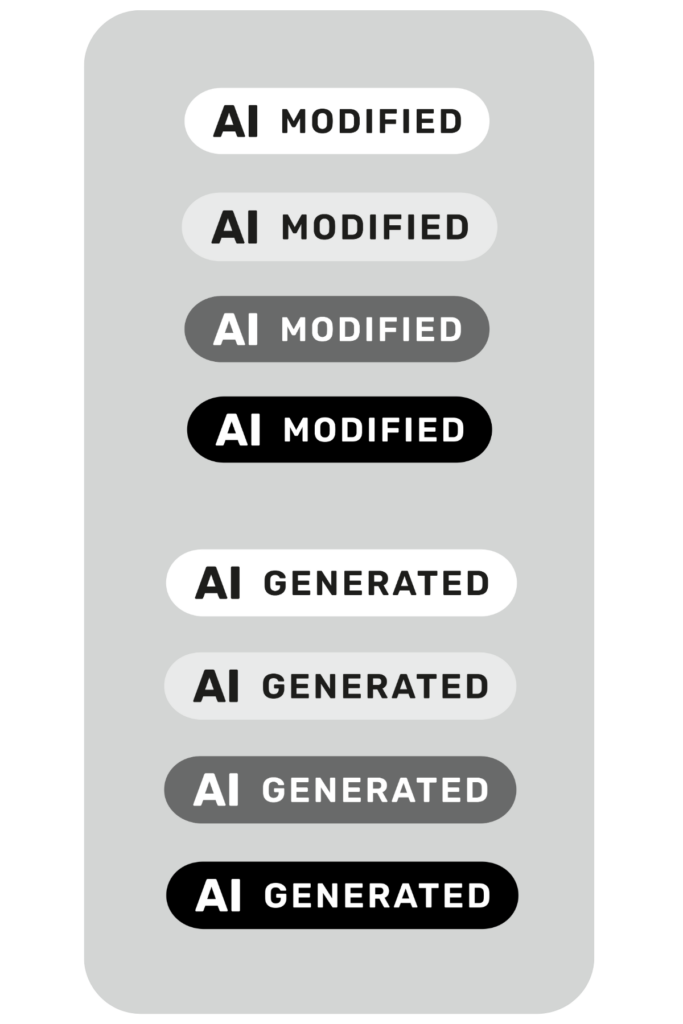
The European Union has proposed official icons that can be used for labeling, for example, a small symbol placed directly on an image or video that displays an explanatory note such as “Generated with AI” when hovered over. The use of these icons is not mandatory, but they are considered a recognized implementation option.
Importantly, the label must remain visible even after the asset has been downloaded. It is not enough for the information to exist only in the metadata — it must remain visible on the asset itself.
As for language, what matters is that the target audience understands the label at first glance.
Machine-readable marking (starting December 2026)
Alongside visual labeling, content must also be marked technically. One well-established option is the IPTC metadata field “Digital Source Type,” which has been used in photography for years and is now gaining new relevance under the EU AI Act.
Typical values in this field include:
- „Trained Algorithmic Media” – for AI-generated content
- „Composite with Trained Algorithmic Media” – for AI-modified content
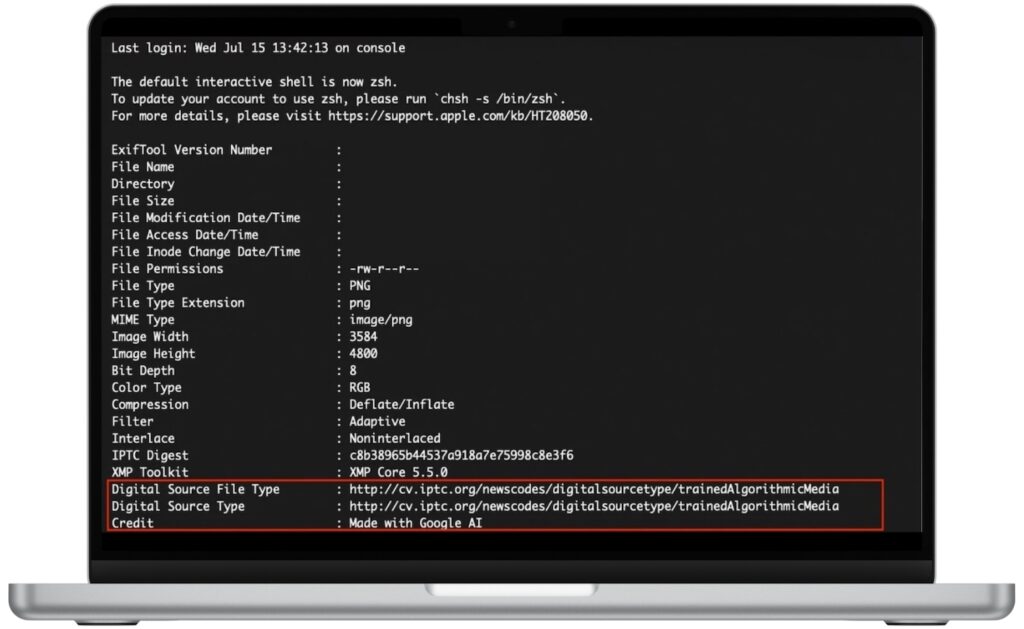
Be aware that many systems automatically strip metadata — for example, when files are uploaded to an online store for performance reasons. Anyone aiming to comply with the machine-readable marking requirement must ensure that this metadata is retained throughout the entire value chain.
What types of content are affected?
The AI labeling requirements under Article 50 of the AI Act do not apply only to images. They extend to all forms of AI-generated or AI-modified content:
- Images: product photos, campaign visuals, lifestyle imagery — wherever AI-generated content appears realistic enough to be perceived as authentic
- Videos and moving-image content: the same requirements apply as for images — both visual and machine-readable marking; ideally the marking should remain visible throughout the video
- Audio: AI-generated voice output or soundscapes
- Text: AI-generated text published without human editorial review for the purpose of informing the public — for example, automatically generated news tickers or match reports
- Print and POS materials: printed publications, posters, and advertising materials are not exempt either
Exception for text: If AI-generated text has undergone a process of human review and editorial control, and a natural or legal person holds editorial responsibility for the publication, the labeling requirement does not apply to that text.

Recommended labeling of AI-generated or AI-modified images, using online stores and catalogs as examples.
What are the risks of non-compliance?
The legislator deliberately set high sanctions in order to ensure compliance with the transparency obligation. Violations of the AI labeling requirements may lead to:
- fines of up to EUR 15 million, or
- 3% of worldwide annual turnover, whichever is higher
In addition, warnings and claims under unfair competition law may also be possible. The message is clear: transparency is not optional — it is mandatory.
What does this mean for your content processes?
Above all, Article 50 of the AI Act requires one thing: clear, well-documented process decisions instead of repeated case-by-case judgments. If you do not yet know at which points AI is used in your content production, now is the time to clarify that.
Here are three questions you should be asking now:
- Do you know where AI elements are contained in your assets? And can you distinguish between fully AI-generated and merely AI-modified assets?
- Is labeling ensured throughout the entire process chain? From creation to publication — including after download?
- Can you pass this information on to your clients or consumers? And do you know what this should look like at each relevant touchpoint?
Our approach at Laudert is simple: when in doubt, label rather than leave unlabeled. All AI-generated content that we create on behalf of our clients is already marked accordingly in the “Digital Source Type” field.
Do you still have questions?
We help you prepare your content processes for August 2, 2026 — in a structured, practical way and with a clear focus on what really matters.
FAQ: AI labeling requirements — the key questions
Do I have to label all AI-generated content?
No — not across the board. The labeling requirement under Article 50 of the AI Act mainly applies where content appears realistic enough to be perceived as authentic (images, videos, audio), or where AI-generated text is published without human editorial review. Purely promotional text that has been reviewed and approved editorially will generally not fall under the requirement.
Do the labeling requirements also apply to content created before August 2, 2026?
What matters is the date of publication, not the date of creation. Content that was already online or already circulating in print before August 2, 2026 does not need to be labeled retroactively. Anything published for the first time after that date — even if it was produced earlier — falls under the requirement.
Is a note in a footnote or below the image sufficient?
No. The label must appear directly on the content and must be recognizable at first glance. Footnotes, asterisk references, or general notices elsewhere on the page are not sufficient.
Must the label remain visible after download?
Yes. The visual label must remain visible on the asset even after download. It is not sufficient for the information to exist only in the metadata.
Are the EU icons for labeling mandatory?
No. The icons proposed by the EU are recommendations, not a legal requirement. What matters is that the label is clear, visible, and understandable for the target audience — including from a language perspective.
What is the difference between AI-generated and AI-modified?
AI-generated means that the asset was originally created by an AI system based on a prompt. AI-modified means that the asset was created through human action and AI was used only as a tool in post-processing. The distinction is also relevant in terms of copyright.
Do I also have to label text?
Yes — but only under certain conditions. AI-generated text must be labeled if it is published without human editorial review and serves the purpose of informing the public. Texts that have been editorially reviewed and for which a person holds editorial responsibility are exempt from the labeling requirement.
What happens if I fail to comply with the labeling requirements?
You may face fines of up to EUR 15 million or 3% of worldwide annual turnover, whichever is higher. In addition, warnings and claims under unfair competition law may also arise.
